
Credit card debt is expensive because interest compounds. Speed comes from a plan plus stopping new charges. You can be careful with money in every other area of life and still feel stuck if revolving balances quietly grow each month. Minimum payments are designed to keep the account open, not to set you free. At All U Want, we treat payoff as a project with a method, a focus target, and a hard rule: freeze new spending on the cards you are trying to eliminate.
This guide walks through listing balances and rates, choosing avalanche or snowball, paying minimums everywhere while attacking one balance, cutting the spending that feeds the cards, and using windfalls without derailing your life. You will also see how to compare high-interest versus lower-interest debt so you aim extra dollars where they matter most.
Why credit cards feel impossible—and why they are not
Cards combine convenience with delayed pain. The purchase is easy. The interest is abstract until the statement arrives. If you pay only the minimum, a large share may cover interest while the principal crawls down. That math is demoralizing, and demoralization leads to avoidance. Avoidance leads to more interest. The loop is mechanical, not a character flaw.
Breaking the loop requires two moves at once: stop adding to the balance, and apply a structured extra payment to principal. Either move alone is weaker. Freezing spending without a payoff method leaves you stuck at a plateau. Making extra payments while still charging groceries on the same card is like bailing a boat with the tap on.
You do not need a perfect budget to start. You need a list of debts, a chosen method, and a first extra payment scheduled for this payday. Clarity beats shame. Shame stalls. Clarity acts.
1. List balances and rates
Know exactly what you owe and the APR on each card. Open every statement or online account and write four columns: card name, balance, APR, and minimum payment. Add the due date if it helps you avoid late fees. This list is your payoff map. Guessing is how people accidentally attack the wrong balance first or miss a due date and add penalty fees.
Include store cards and any card you cosigned that you are responsible for paying. Do not include mortgage or federal student loans in this card-focused project unless you are only comparing interest rates for prioritization. For a deeper comparison of why rate differences matter across debt types, read high-interest vs low-interest debt.
Total the balances. The total may sting. Write it anyway. Then total the minimum payments. That number is your baseline obligation before any acceleration. Everything above the minimums is your payoff fuel. If you do not yet know where extra fuel will come from, your next step after listing is a quick spending review to find it—subscriptions are a common source of quiet leaks.
Update the list monthly. Balances change. Sometimes a promotional APR ends. Sometimes a payment posts late. A living list keeps the plan honest.
2. Pick avalanche or snowball
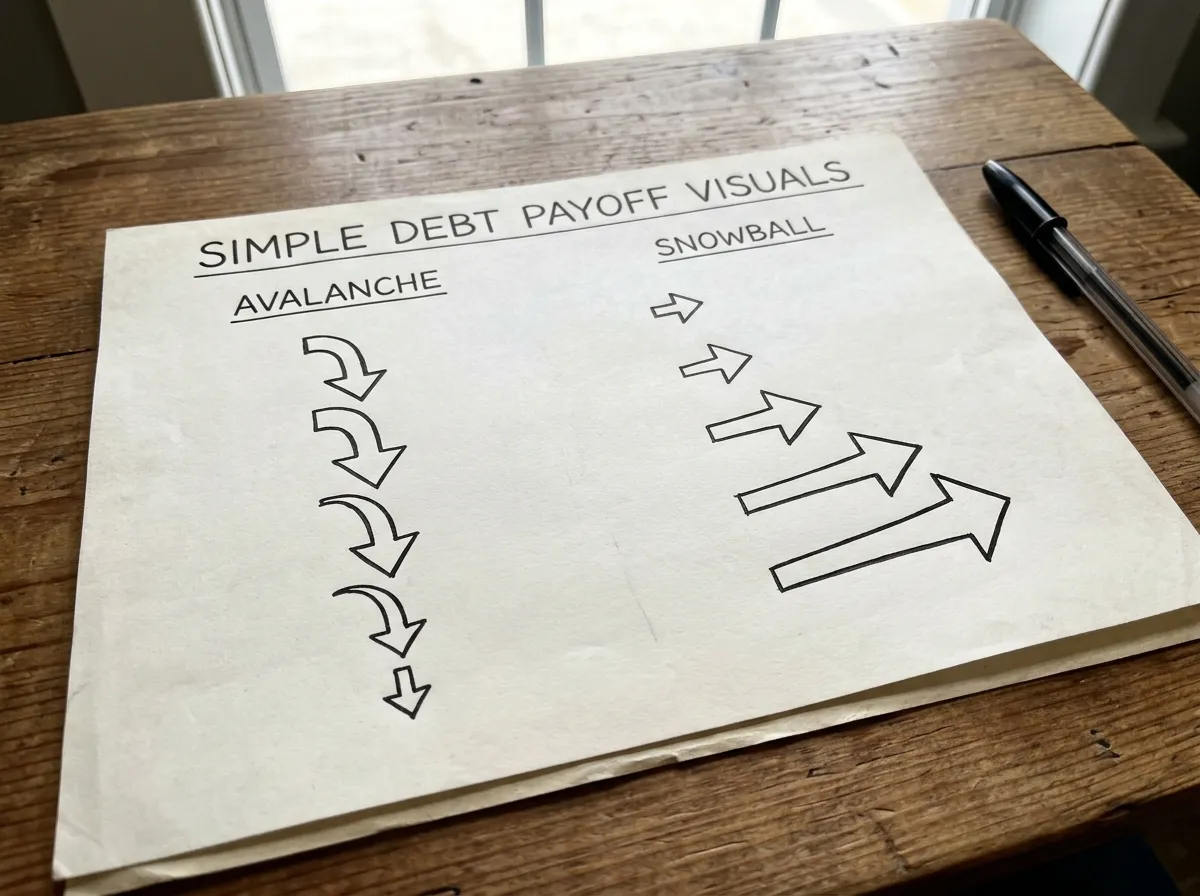
Avalanche attacks highest APR first. Snowball attacks smallest balance first for momentum. Both work when you stick with them. Avalanche usually costs less interest over time because expensive debt dies sooner. Snowball often feels better early because you get a quick win when a small card hits zero. Choose the method you will continue when motivation dips—not the method that sounds smarter on a podcast.
Avalanche method: order cards by APR, highest to lowest. Pay minimums on all. Put every extra dollar toward the highest APR card until it is gone. Then roll that payment into the next highest APR. Repeat. This is the mathematically efficient path for most people with large rate gaps.
Snowball method: order cards by balance, smallest to largest, regardless of APR. Pay minimums on all. Put every extra dollar toward the smallest balance. When it clears, roll the payment to the next smallest. The emotional win of closing an account (or at least a balance) can sustain behavior change. If your APRs are similar, snowball’s interest penalty versus avalanche may be small.
Hybrid options exist. Some people knock out a tiny balance first for a win, then switch to avalanche. That can be reasonable if the tiny balance would clear in one or two paychecks. Do not hybrid yourself into chaos with constant reordering. Pick a rule and keep it for at least 90 days unless rates change dramatically.
3. Pay minimums on all, extra on one
Focus creates progress you can see. Scattershot extra payments across every card feel busy and look flat. Concentrated extras create a visible downward line on one balance. That visibility matters. Humans persist when progress is obvious.
Automate minimum payments on every card so late fees never undo your work. Then automate or manually schedule the extra payment to the focus card on payday. If cash timing is tight, pay minimums early in the cycle and send extras immediately when income arrives. The order of operations is: protect due dates, then accelerate principal.
When a focus card hits zero, do not shrink the total payment amount. Roll the entire payment you were making—minimum plus extra—onto the next target. This rollover is the engine of both avalanche and snowball. Shrinking the payment when a card clears is how payoff timelines quietly double.
Track the focus balance weekly if that motivates you, or biweekly on payday. Avoid checking so often that small interest postings discourage you. Principal reduction after each extra payment is the signal that counts.
4. Freeze new spending on those cards
Use debit or a paid-in-full card for daily purchases. A payoff plan cannot outrun new charges on the same revolving balances. Remove the focus cards from digital wallets. Store them out of easy reach if temptation is high. Leave one card available only for true emergencies—or none, if that is safer for you and you have a small cash cushion.
Move recurring subscriptions off cards you are paying down. Billing that keeps hitting a focus card recreates the balance you are trying to destroy. While you are at it, cancel what you do not use. Subscription creep funds interest for banks, not your freedom. For a practical cut list, use how to cut subscriptions.
If you need a credit card for travel or credit-building, use a different card that you pay in full every statement—ideally one with no revolving balance. Paying in full means interest never starts. That card is a payment tool. The indebted cards are a payoff project. Do not mix the jobs.
Plan for categories that used to land on credit. Groceries, gas, and routine shopping need a debit-funded budget. If your checking account cannot handle those yet, fix the cash-flow plan before you expect the freeze to stick. A freeze without groceries funding becomes a freeze that thaws on aisle seven.
Find payoff fuel without a total life rewrite
Extra payments come from somewhere: lower spending, higher income, or temporary reallocation. Start with the least dramatic cuts that free cash quickly. Unused subscriptions, dining delivery frequency, unused memberships, and impulse shopping caps often free money within a week. Sell unused items if that fits your life. Pick up a short-term shift or freelance task if your energy allows. Redirect windfalls—tax refunds, bonuses, gifts—toward the focus card before lifestyle upgrades.
Build a bare-bones spending plan for the payoff season. This does not have to be forever. It is a project budget. Define an end-state reward that is not a new revolving charge: a celebration meal paid in cash when a card hits zero, or a small transfer to savings when the rollover begins on the next card.
Keep a tiny emergency starter if you can, even during aggressive payoff. A few hundred dollars of cash prevents a flat tire from becoming a new card balance. Payoff speed matters. Avoiding new debt matters more.
Interest, minimums, and the story statements tell
Read one statement carefully. Find the interest charged, the minimum due, and the time-to-pay estimate if you pay only the minimum. That estimate is often years long. Use it as motivation, not as destiny. Your plan replaces that default timeline.
If your APR is variable, expect it to move with broader rates. Recalculate occasionally. If a card offers a temporary hardship program or a lower rate for automatic payments, ask—politely and in writing when possible. A lower APR accelerates any method you choose. Be cautious with balance transfer offers: they can help if fees are low, the promotional period is long enough, and you stop charging on both cards. They hurt if you transfer, then refill the old card.
Understand that minimum payments often shrink as balances shrink. That is why rolling the full previous payment amount to the next card is essential. If you let payments shrink to the new minimums, you donate speed.
Avalanche vs snowball: a practical decision guide
Choose avalanche if your highest APR is meaningfully higher than the others, you are motivated by saving interest, and you can tolerate a longer wait before the first account hits zero. Choose snowball if you have several small balances, you have quit payoff plans before, or you need an early win to believe the project is real. If APRs are within a couple points and balances vary widely, snowball’s behavioral benefit may outweigh a modest interest difference.
Write the order of cards on paper and tape it near your workspace or save it as a phone note titled “Payoff order—do not reshuffle.” Reshuffling every time a statement arrives is a procrastination costume.
What to do mid-month when something breaks
Life will interrupt. A medical bill, a job gap, a car repair. Use cash reserves if you have them. Negotiate due dates if needed to avoid late fees. Reduce extras temporarily, then resume. Try not to add new revolving charges on the focus cards. If you must use credit for a true emergency, document it, adjust the payoff timeline, and return to the freeze as soon as cash flow stabilizes.
Missed perfection is normal. Abandoned plans are optional. Restart on the next payday without a dramatic restart ritual. Pay the minimums you owe, send whatever extra you can to the focus card, and keep going.
Measuring progress the useful way
Track three numbers monthly: total card debt, focus-card balance, and total amount paid above minimums. Total debt should trend down. Focus balance should drop faster. Extra paid is your effort metric. Credit scores may move around as utilization changes; do not obsess daily. Utilization often improves as balances fall, especially when you keep accounts open after payoff unless there is a strong reason to close them.
When a card hits zero, decide whether to close it or keep it open with no stored payment methods and no carrying balance. Closing can simplify temptation. Keeping it open can help average account age and available credit. Choose based on your behavior risk, not internet arguments. If a card triggers spending, close or freeze it hard.
Common payoff mistakes
Paying random extras without a focus order. Continuing to charge on the same cards. Ignoring due dates while celebrating a big principal payment. Draining every dollar of cash so the next surprise becomes new debt. Balance-transferring without a plan to stop new charges. Waiting for a “better month” to begin. The best month is the one that starts with a list and an automated minimum.
Another mistake is cutting so hard that the plan becomes miserable and collapses. Sustainable intensity beats a two-week crash diet followed by a binge on the card. Build a plan you can run for months.
A 60-minute launch plan
Minutes 0–15: list every card with balance, APR, and minimum. Minutes 15–25: choose avalanche or snowball and number the order. Minutes 25–40: automate minimums; schedule the first extra payment to card one. Minutes 40–50: remove focus cards from wallets and move subscriptions off them. Minutes 50–60: cut one or two obvious expenses and note the dollar amount now available monthly. Write one sentence: “No new charges on payoff cards; extras go to card one.” That is your policy.
Next, deepen the fuel source. Audit subscriptions with a hard cancel pass. Compare whether any non-card debt should wait while high-APR cards die first using the high-interest versus low-interest framework linked above. Revisit the plan every payday for five minutes: Did minimums clear? Did the extra post? Is the freeze intact?
After the last card is clear
Do not immediately expand lifestyle by the full payoff amount. Keep the payment habit alive for at least one or two months by redirecting the entire former card payment into savings or a remaining lower-priority debt. This locks in freedom. Then choose a sustainable split between lifestyle restoration and long-term goals. The skill you built—automation, focus, spending freezes—transfers cleanly to emergency funds and investing pipelines.
Also write a short “never again” rule for revolving balances. Example: any card must be paid in full monthly, or it stays at home for the week. Rules prevent silent relapse.
Quick tip
Any windfall goes to the focus card before lifestyle upgrades. Tax refunds, bonuses, and gifts clear principal fast. Celebrate after the payment posts, not before.
FAQ
How long does this take? Setup can start in under an hour. The payoff timeline depends on balances, APRs, and how much extra you can send. Most people can start in under an hour and refine over a week.
Do I need special tools? No. A one-page list, autopay for minimums, and a calendar reminder for extras are enough. Simple defaults beat complicated setups you abandon.
Should I use avalanche or snowball? Avalanche saves more interest when rate gaps are wide. Snowball can be easier to stick with. Pick the one you will continue.
What if I cannot pay more than the minimums yet? Freeze new charges, cut one expense category, and build a small surplus. Even small extras matter when they are consistent. Protect due dates first.
Is consolidating smart? It can be, if the new rate is lower, fees are reasonable, and you do not refill the old cards. Consolidation without a spending freeze often recreates the problem.
Should I pause investing to pay cards? Often yes for high-APR cards, especially above typical long-term market assumptions—except for capturing a full employer match if available. Compare rates with a clear head using a high- vs low-interest framework.
What about my credit score? Late payments hurt. Falling balances usually help utilization over time. Prioritize on-time payments and principal reduction over score-watching.
Related: High-Interest vs Low-Interest Debt · How to Cut Subscriptions