
Habit stacking ties a new behavior to one you already do. Instead of waiting for motivation to arrive on a blank calendar, you attach a tiny action to a cue that already survives busy days: opening the laptop, pouring coffee, ending a meeting, locking the door. The old habit becomes the hook. The new habit rides along.
All U Want focuses on stacks you can use on real workdays—not fantasy mornings with two free hours and a mountain vista. The stacks below are short, specific, and easy to shrink when life gets loud. Use them to start focus, protect health basics, handle money admin, and close the day without inventing a brand-new routine from scratch.
If mornings are your anchor, connect stacks to a morning routine that sticks. If priorities keep drifting, pair stacks with the best daily priorities method so the habits serve outcomes instead of becoming empty rituals.
Why stacking works when resolutions fail
Most failed habits die from missing cues. You planned to stretch, journal, or review priorities “sometime today.” Sometime is not a cue. Existing routines already have cues: time, place, preceding action. Stacking borrows that reliability.
Stacking also reduces identity drama. You are not becoming a new person overnight. You are inserting one small step after a step you already take. Success feels ordinary, which is exactly why it repeats.
- Cues beat willpower on tired afternoons.
- Tiny first versions defeat all-or-nothing collapse.
- Workday stacks must tolerate meetings and interruptions.
- One new stack per week keeps the system learnable.
Think of your day as a chain of automatic scenes: wake, commute or log in, lunch, last meeting, shutdown. Each scene edge is a stacking opportunity. You only need a few edges to change the shape of a week.
1. Use the formula
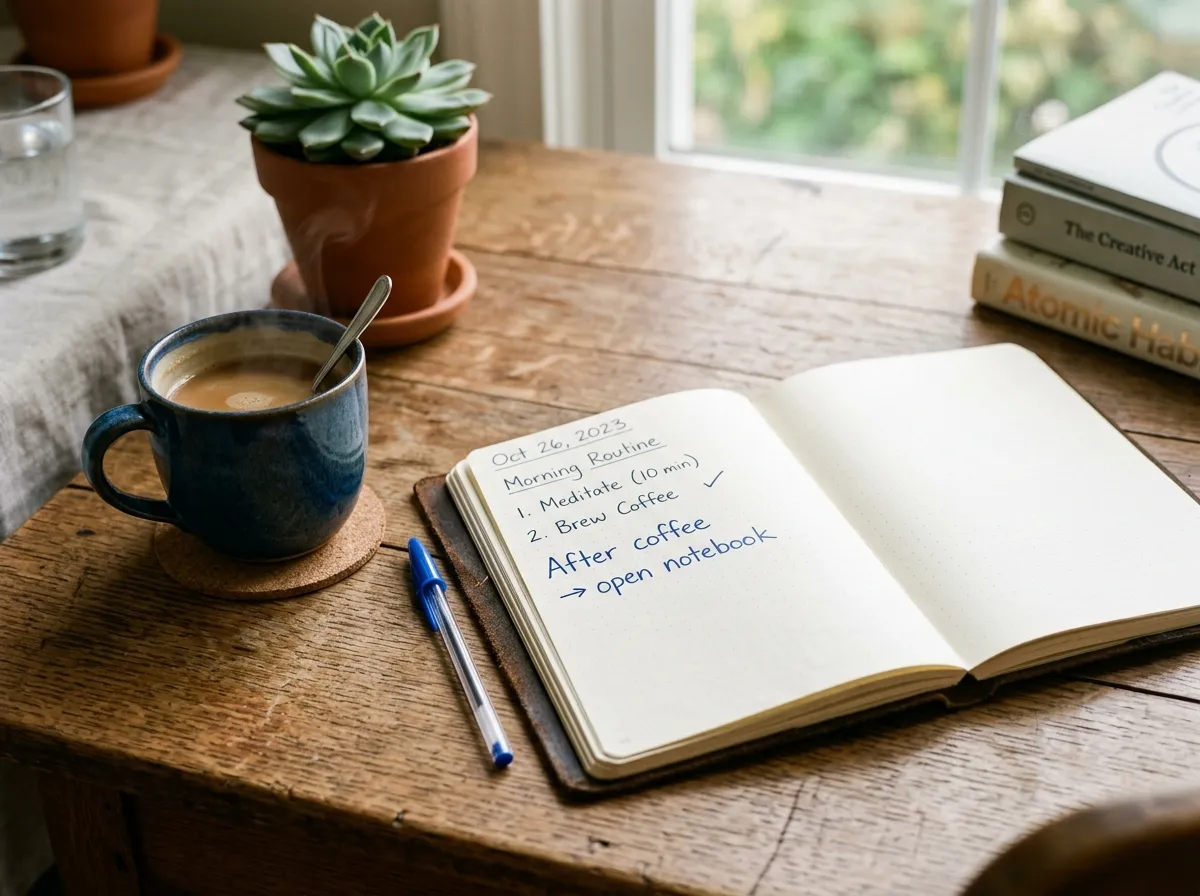
After [current habit], I will [new habit]. Keep it tiny. If the new habit needs more than two minutes in its first version, shrink it until it does. You can grow later. You cannot grow what never starts.
Good formula examples:
- After I pour coffee, I will write my Big Three on a sticky note.
- After I open my laptop, I will put my phone in a drawer.
- After I end my last meeting, I will capture open loops for two minutes.
- After I shut the laptop, I will charge my phone outside the bedroom.
Bad formula examples usually hide vagueness or ambition: “After work I will get healthier,” “After breakfast I will become organized,” “After I feel ready I will start.” Feelings are poor cues. Visible actions are better.
Design rules for workday stacks
- Same context: stack where the cue naturally happens.
- Immediate: new habit starts within seconds of the cue.
- Obvious: leave tools in the path (notebook on keyboard, bottle by bag).
- Kind: if you miss, restart at the next cue without a shame spiral.
Write the stack sentence somewhere you see it for the first week. Spoken formulas fade under email volume. A sticky on the monitor is underrated infrastructure.
2. Stack work openers
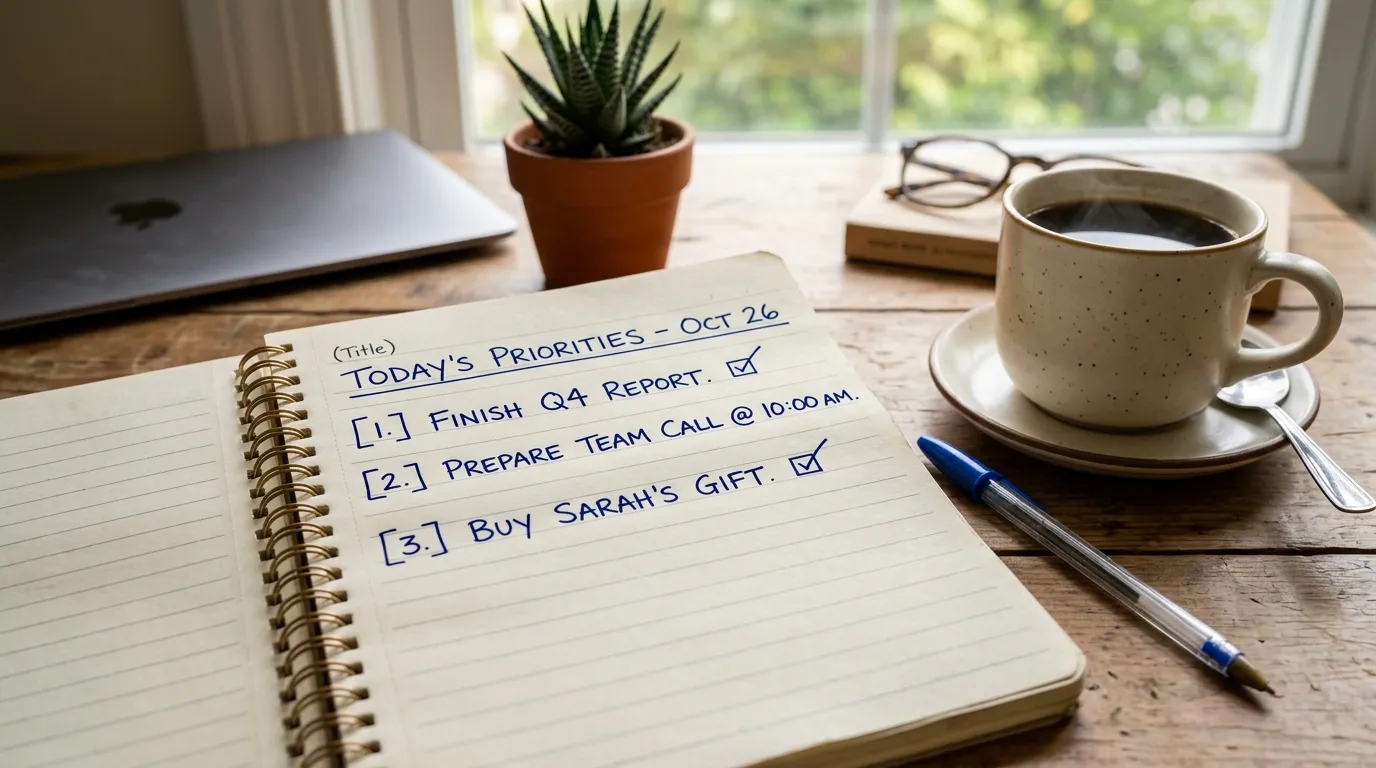
After opening your laptop, write your Big Three. That single stack prevents the most common knowledge-work failure: starting the day inside someone else’s inbox. The cue is reliable. The action is short. The payoff compounds.
Make the opener even tighter if needed: after opening the laptop, write only the first task of the day. You can expand to three once the stack is automatic. Pair with calendar reality—if mornings are meeting-heavy, your opener might be “after the first meeting ends” instead of “after laptop opens.”
Other opener stacks that fit real jobs:
- After I sit at my desk, I will put on headphones and start a 25-minute timer.
- After I unlock my work phone, I will switch it to Do Not Disturb until lunch.
- After I log into chat, I will set status to Focusing for 90 minutes.
- After I open the project folder, I will reread yesterday’s next-action line.
Openers fail when they depend on perfect mornings. Build a late-start variant: after I join late, I will still write one priority before touching email. Continuity matters more than aesthetic compliance.
Connect openers to priority clarity. Habit stacks are empty if they decorate a random to-do list. Use a simple daily priorities approach so the Big Three are chosen with intention, not copied from noise. The best daily priorities method gives that decision structure without a heavy system.
3. Stack money and digital habits
Admin habits die when they require a special mood. Attach them to weekly anchors you already keep. After Friday lunch, run a ten-minute money date: check balances, note upcoming bills, move a small transfer if that is your plan. The lunch cue recurs. The review stays short enough to survive.
More money and digital stacks for ordinary weeks:
- After I get a paycheck alert, I will move the planned save amount before spending.
- After I pay a subscription invoice, I will ask whether to keep, cancel, or downgrade.
- After I upload a file to drive, I will put it in the correct folder immediately.
- After I finish a video call, I will delete or rename the temporary download pile.
- After I add a browser bookmark, I will tag it or file it so Read Later does not become a junk drawer.
Digital clutter is usually a missing stack, not a missing weekend purge. Tiny file habits after existing actions prevent the quarterly despair clean-up. Money stress often shrinks when reviews are scheduled by cue instead of postponed until anxiety spikes.
If Friday lunch is unreliable, choose a sturdier anchor: after Thursday’s last meeting, after Sunday coffee, after you submit timesheets. The best cue is the one that already happens.
4. Review and adjust
If a stack fails twice, shrink it or change the cue. Failure is information. Maybe the cue does not actually happen. Maybe the new habit is still too big. Maybe the context is wrong—trying to stretch at a standing desk you never stand at.
Run a weekly two-question review:
- Which stacks fired without debate?
- Which stacks stalled, and was the problem cue, size, or friction?
Adjust one variable at a time. If you change cue and size and location simultaneously, you will not learn what worked. Keep a simple note of stack versions so you remember that “write Big Three” used to be “write one word priority” in week one.
Retire stacks that outlived their purpose. Once phone-in-drawer is automatic, you may not need the sticky prompt. Once money dates are habitual, you might stack a deeper quarterly review onto them. Stacking is scaffolding. Scaffolding can come down—or support the next floor.
Full workday stack map (copy and adapt)
Use this as a menu, not a mandate. Pick two or three to start.
Morning edge
- After I turn off the alarm, I will drink a glass of water.
- After I start the kettle, I will open the curtains.
- After I pour coffee, I will write Big Three.
- After I pack my bag, I will put the phone on silent.
Morning stacks pair well with a durable morning routine. Keep the routine short enough that stacks remain enjoyable, not another performance.
Start-of-work edge
- After I open the laptop, I will launch the task list before email.
- After I write Big Three, I will start the first deep-work block.
- After I finish the first block, I will stand and refill water.
Midday edge
- After I microwave lunch, I will step outside for three minutes.
- After I return from lunch, I will clear the desk surface.
- After I check chat at noon, I will batch replies for fifteen minutes only.
Afternoon edge
- After my last recurring meeting, I will capture leftovers.
- After I send the last email, I will close the inbox tab.
- After I shut down apps, I will note tomorrow’s first action.
Evening edge
- After I plug in the laptop, I will plug the phone in another room.
- After I wash the dinner plate, I will lay out tomorrow’s clothes.
- After I set an alarm, I will open a paper book for five pages.
Notice how each new habit is small and physically obvious. That is the design standard. If a stack requires a perfect mood, redesign it.
Habit stacks for focus, meetings, and collaboration
Knowledge work needs social stacks too—behaviors that protect attention without making you unreachable.
- After I accept a meeting, I will check whether an agenda exists; if not, I will ask for one.
- After a meeting ends, I will write owners and dates before switching tasks.
- After I feel the urge to “quickly check” chat, I will write the urge in a parking lot note.
- After I complete a deep block, I will send one proactive update so people interrupt less later.
These stacks turn good intentions into cues. “I should run better meetings” fails. “After I accept an invite, I ask for three agenda bullets” succeeds more often because the trigger is concrete.
Stacks for energy and body (without a life overhaul)
Workdays punish bodies that only move between chair and fridge. Attach micro-movement to cues you already obey.
- After a video call ends, I will do ten shoulder rolls.
- After I send a large file, I will walk to get water on another floor or room.
- After I eat lunch, I will walk to the end of the block.
- After I close the laptop, I will change into non-work clothes as a state shift.
Keep health stacks embarrassingly small at first. Identity grows from repetition, not from heroic day one. If you want larger training habits, stack the preparation: after breakfast, I will set out workout clothes. Preparation stacks often succeed where the full workout stack fails.
Team and household stacking
Stacks can be shared. Couples, roommates, and teams can attach group behaviors to shared cues.
- After Sunday coffee, we will run a ten-minute household money check.
- After the weekly team meeting, we will cancel one obsolete recurring invite.
- After dinner, we will park phones in a basket until dishes are done.
- After standup, each person will post one blocker in writing.
Shared stacks need shared language. Write the formula where everyone sees it. Review monthly. Drop what feels preachy. Keep what reduces friction.
How to add stacks without overload
Add one new stack per week. That pacing feels slow and works. Each stack needs reps to become automatic. Stacking five new behaviors on Monday creates a second job called “remembering stacks.”
Sequence matters. Install openers before complex evening routines. Install capture stacks before ambitious planning stacks. Foundations first. When a stack is automatic for two weeks, you have earned the next one.
Track lightly: a calendar dot on days the stack fired. You are not grading your soul. You are checking whether the cue is doing its job. If dots are rare, redesign. If dots are dense, celebrate privately and move on—over-celebration can make habits weirdly fragile.
Examples of shrinking a stack until it sticks
Suppose you want “after lunch, walk twenty minutes.” If it fails twice, shrink: after lunch, walk to the corner and back. Still failing? After lunch, put on shoes and step outside for one minute. The cue stays. The payload shrinks until friction disappears. Later you grow the walk again because the cue is already owned.
The same shrink logic applies to planning: after opening the laptop, write three priorities may fail on chaotic days. Shrink to one word on a sticky. After two weeks of automatic stickies, expand back to Big Three. Stacking is iterative engineering, not a loyalty test to your original ambition.
- Keep the cue; shrink the action.
- Grow only after two weeks of easy reps.
- Write the current formula so you remember the live version.
- Never punish a miss with a doubled stack the next day.
Quick tip
Add one new stack per week. Protect the pacing even when you feel inspired. Inspiration is great for choosing the next stack, poor for installing ten at once.
FAQ
How long does this take? Writing your first stack formula takes minutes. Making it automatic usually takes days to a couple of weeks of real cues. Refine over a week of practice, then add the next stack.
Do I need special tools? No. A sticky note and an honest cue beat habit apps you ignore. Apps can help reminders, but the stack lives in behavior, not badges.
What if my schedule changes every day? Choose cues that travel: opening a laptop, ending calls, eating lunch, locking a door. Avoid cues tied to rare perfect mornings.
Can I stack big habits? Start tiny, then scale the same cue. After coffee, stretch for one minute; later, after coffee, stretch for five. Same hook, bigger payload.
What if I miss several days? Restart at the next cue without a make-up marathon. Missing is normal. Returning is the skill.
Related: Morning Routine That Sticks · Best Daily Priorities Method