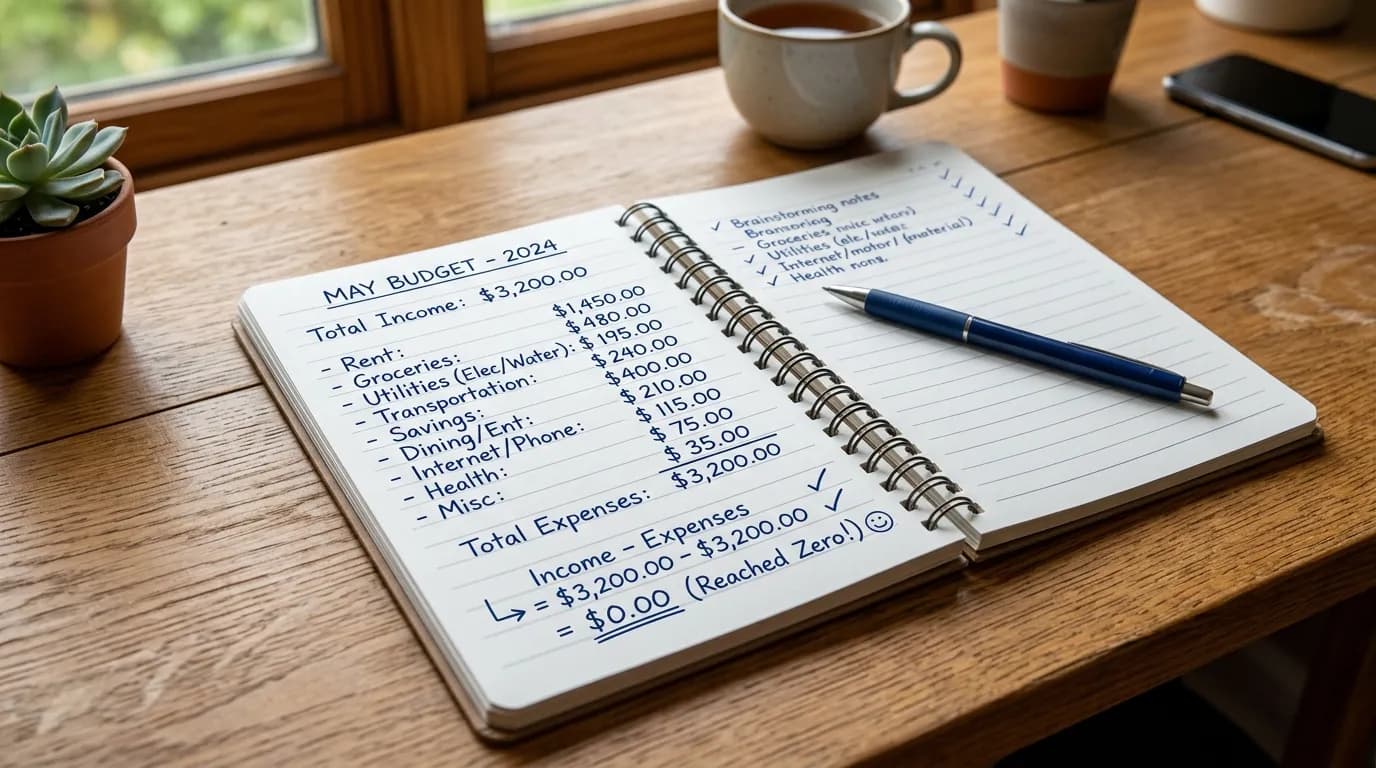

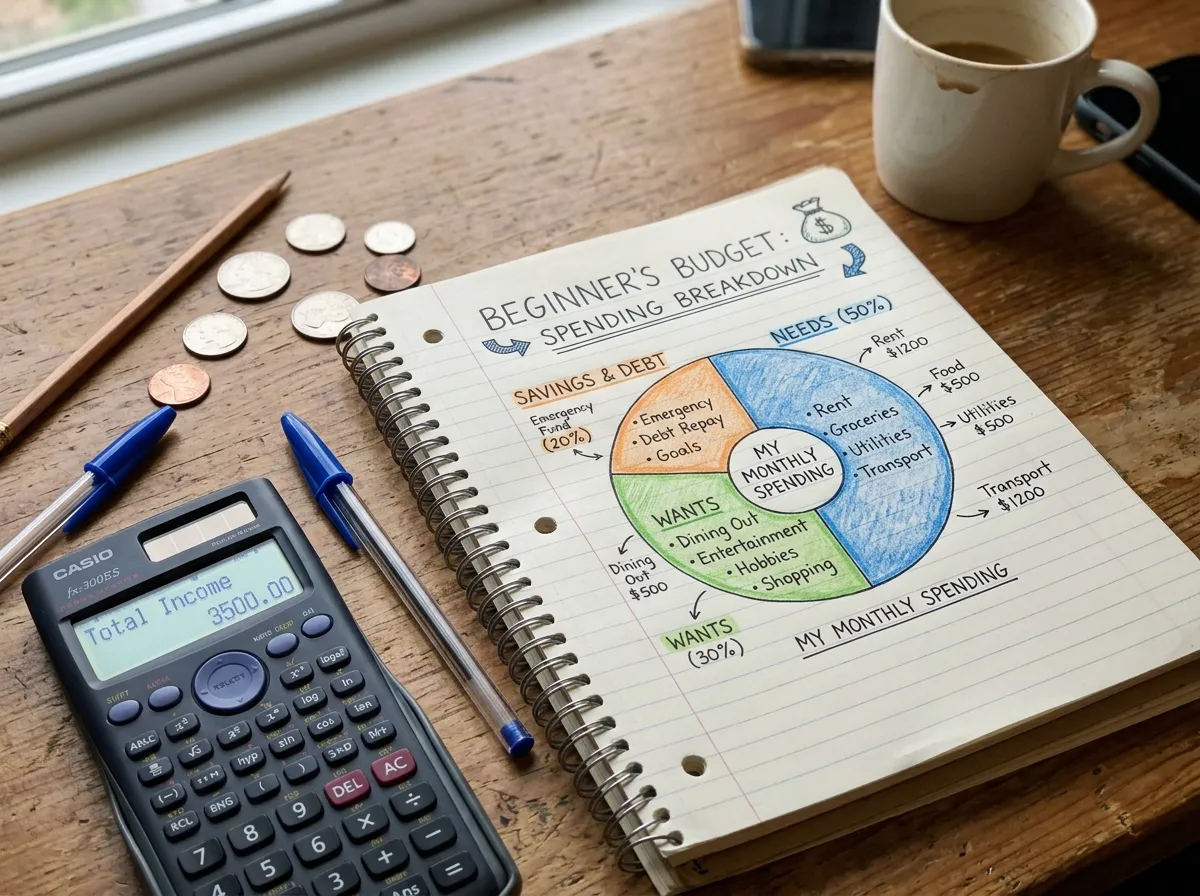
The 50/30/20 rule is one of the friendliest ways to start budgeting when you have never tracked money before. It splits take-home pay into three buckets: roughly half for needs, about thirty percent for wants, and about twenty percent for savings and debt payoff. Think of it as a first map of your money, not a permanent cage. The point is clarity, not perfection, and nothing here is personal financial advice—just practical money basics you can try and adjust.
Many beginners abandon budgets because the first version feels too tight, too vague, or too spreadsheet-heavy. The 50/30/20 framework avoids that trap by giving you three clear questions each month: Did needs stay near half? Did wants stay near thirty percent? Did future-you get roughly twenty percent? If one answer is “not yet,” you know where to look. That is enough structure to build a habit without turning every coffee into a moral crisis.
On All U Want we treat money basics as skills you practice, the same way you practice a morning routine or a cleaner digital workspace. You will see sample numbers throughout this guide. Those figures are illustrations so the math feels concrete. Your rent, city, income, and family situation will differ, so treat every dollar amount as a teaching example, not a prescription.
What the three buckets actually mean
Needs are the costs that keep life running and safe: housing, basic utilities, groceries that feed you, essential transport to work, insurance premiums you already carry, and the minimum payments required on any debt. If skipping the payment would cut off a service, risk eviction, or damage your credit in an obvious way, it usually belongs in needs. A simple test helps: “Would I still pay this if my income dropped by a third tomorrow?” If yes, it is probably a need.
Wants are the choices that make life enjoyable: dining out, streaming stacks, hobbies, nicer clothes than bare necessity, weekend trips, and the “nice to have” upgrades. A phone plan that lets you work and call family can be a need; the unlimited data add-on and device upgrade cycle often sit in wants. Groceries are a need; the specialty dessert run every Friday is a want. This split is not about shame. It is about seeing how much room joy already takes so you can keep joy on purpose.
Savings and debt get the third bucket. That includes emergency cash, retirement contributions you choose to make from take-home pay, extra debt payments above the minimum, and goal savings like a first-month rent buffer or a future move. Minimum debt payments stay in needs; anything extra that shrinks the balance faster usually counts toward the twenty percent. If that feels confusing at first, label two lines: “debt minimums (needs)” and “debt extra (savings bucket).” Clarity beats clever labels.
1. Calculate take-home pay the honest way
Start with the money that actually lands in your account after taxes and required deductions. If you are paid twice a month, add two typical deposits. If you are paid weekly, multiply a normal week by about 4.3 to estimate a month, or add four recent paystubs and average them. Gig or freelance income should use a conservative average from the last three months, not your best month. Budgeting hope as income is how “50/30/20” becomes fiction by week two.
Illustration: Maya brings home about $3,200 in a typical month after taxes. Her 50/30/20 sketch is $1,600 needs, $960 wants, and $640 savings and debt. Those are targets, not courtroom evidence. If her rent alone is $1,450, she already knows needs will run hot and wants or the savings slice will need temporary pressure. Seeing that early is the win—not pretending the percentages will magically fit her city.
If income varies, build the plan on a “floor” number you can usually count on, then decide in advance where surplus goes when a better month arrives. Example: Jordan’s floor is $2,400 take-home. On months that hit $2,900, the extra $500 might split as $300 to savings and $200 to a debt payoff or a planned fun fund. Writing that rule once prevents surplus from dissolving into random spending.
Side note for people with benefits: if your employer contributes to retirement before you see the money, that contribution is still valuable, but it is not part of the take-home pie you are splitting. The 50/30/20 rule works on cash you control. Celebrate workplace benefits separately so you do not double-count money you never touch.
2. Split 50 / 30 / 20 and write the three targets
Once you have take-home pay, multiply by 0.50, 0.30, and 0.20. Put those three numbers at the top of a notes app, notebook page, or simple spreadsheet. Then list real categories underneath each bucket. The percentages are the ceiling sketch; the categories are where life happens. Without categories, “50% needs” stays abstract and you cannot tell whether groceries or rent is the pressure point.
Illustration using $4,000 take-home: needs target $2,000, wants target $1,200, savings and debt target $800. Under needs you might see rent $1,350, utilities $180, groceries $350, transit pass $90, insurance $80, debt minimums $150—total $2,200. That is $200 over the fifty percent line. Under wants: dining $280, subscriptions $65, hobbies $120, misc shopping $200—total $665, which is under thirty percent. Savings currently at $400. The story is clear: needs are heavy, wants have room, savings is short. A beginner can act on that story without a finance degree.
If fifty percent for needs is impossible in your housing market, do not throw out the whole method. Temporarily run a “city version” such as 60/25/15 or 65/20/15 while you work on income, housemates, or a later move. The educational value of 50/30/20 is the three-bucket thinking, not the exact digits. Keeping a visible savings line—even at ten or fifteen percent—beats abandoning the plan because rent exceeded a textbook chart.
3. List needs honestly without inflating the bucket
Beginners often hide wants inside needs. “I need this coffee to function” can be true emotionally and still belong partly in wants for budgeting purposes. Be kind and precise. Housing, heat, water, electricity, basic phone, essential groceries, required insurance, childcare that enables work, and minimum debt payments are classic needs. Gym memberships, premium streaming, brand-name everything, and frequent takeout are usually wants—even if they feel non-negotiable today.
Groceries deserve a special note. Food is a need; the style of food shopping is adjustable. If your grocery line is $600 for one person and half of that is convenience meals, you can keep a solid grocery need (say $350–$400 in an illustration) and move the convenience premium into wants. That single re-label often reveals twenty percent “savings room” you thought did not exist, without pretending you will cook every meal from scratch forever.
Transport works the same way. A bus pass or basic fuel to get to work is a need. Ride-hail three nights a week because planning feels hard is often a want pattern. You do not have to eliminate it on day one. You only need to see it. When wants are visible, you can choose them proudly instead of wondering where the paycheck went.
Insurance and debt minimums belong in needs because skipping them creates larger problems. Extra payments toward a credit card or student loan can live in the twenty percent bucket. That separation teaches a useful habit: keep the lights on first, then accelerate freedom with intentional surplus.
4. Adjust to your city, season, and life stage
A first job in a high-rent city will not look like a mid-career budget in a lower-cost town. Roomates, partner income, student loans, and kids change the shape of the pie. Use 50/30/20 as a conversation with reality. If needs sit at sixty-five percent for six months, your job is not to feel guilty—it is to pick one lever: raise income, lower housing over time, shrink wants gently, or accept a smaller savings percentage while you stabilize.
Seasonality matters too. Winter utilities, summer travel, back-to-school costs, and holiday months can blow a neat percentage plan. One practical approach is to keep the annual view in mind: if December wants run hot, November and January can run cooler, or you can pre-save a holiday line inside the twenty percent bucket earlier in the year. The rule still helps because you notice the swing instead of being surprised by it.
Illustration: Sam’s needs average fifty-eight percent most months. Instead of quitting budgeting, Sam caps dining and hobby spending for one quarter and redirects $150 per month to a “move fund.” After nine months, that is about $1,350 toward a future housing change. The percentages improve because Sam treated 50/30/20 as a dashboard, not a grade.
Life stage also changes what “twenty percent” should prioritize. Early on, a starter emergency fund and high-interest debt often deserve the first claim on that bucket. Later, retirement and medium-term goals may share it. The framework stays; the contents of the savings bucket evolve. That evolution is normal and healthy.
A walkthrough month with sample numbers
Imagine Alex, take-home $3,600. Targets: needs $1,800, wants $1,080, savings and debt $720. Actual draft: rent $1,400, utilities $160, groceries $380, phone $45, transit $100, debt minimum $120 → needs $2,205. Wants draft: restaurants $250, streaming $40, clothes $80, games $60, misc $100 → $530. That leaves $865 before savings assignments ($3,600 − $2,205 − $530). Alex can fund $720 toward goals and still have $145 as a buffer or extra debt payment. Needs are over the fifty percent line by $405, but wants are far under thirty percent, so the plan still works. The educational lesson: balance the whole pie, not each slice in isolation on week one.
Alex’s action list for the next thirty days might be tiny: pack lunch twice a week to ease grocery creep, cancel one unused subscription, and automate $400 on payday toward emergency savings while putting $320 extra toward the card with the highest interest. None of those moves require a perfect fifty percent needs number. They require seeing the buckets.
If Alex’s income later rises to $4,000 take-home, the old wants habits might expand to fill the new space. A 50/30/20 check after a raise prevents lifestyle creep. Keep needs from rising automatically, let some of the raise enlarge the twenty percent bucket, and decide consciously how much of the rest becomes fun. That is how the beginner rule stays useful after the beginner phase.
Common mistakes that make 50/30/20 feel broken
Using gross pay instead of take-home pay inflates every target and guarantees disappointment. Forgetting irregular bills—annual insurance, car registration, gifts—makes months look fine until a spike hits. Fix that by averaging known annual costs into a monthly “irregular” need or by parking money for them inside savings. Calling everything a need removes the usefulness of the wants bucket. Ignoring the savings bucket because “there is nothing left” often means wants were never counted honestly.
Another mistake is changing the plan every three days. Give a draft two to four weeks. Track roughly. Then adjust one category. Constant reinvention feels productive and produces no data. Pair this framework with a short monthly reset—our guide on building a monthly budget in 30 minutes is designed for that reset—so 50/30/20 stays a living sketch instead of a forgotten screenshot.
Comparing your percentages to a stranger online is also a trap. Someone with paid-off housing and no dependents can hit twenty percent savings casually. Someone supporting family or paying city rent may celebrate ten percent with equal integrity. Education beats comparison. Your dashboard is yours.
How 50/30/20 connects to tighter methods later
When you outgrow broad buckets, you can keep the spirit and add detail. Zero-based budgeting asks you to give every dollar a job until income minus assignments equals zero. That is a natural next step once 50/30/20 shows you the big picture. If you want that deeper assignment style, read zero-based budgeting for first-timers after you have a month of real spending data. Starting with buckets, then moving to dollar jobs, is a kinder learning path than jumping straight into a full ledger.
You can also keep 50/30/20 as the “altitude view” and use category caps underneath. Needs stay near half; within needs, groceries get a soft cap. Wants stay near thirty percent; within wants, dining gets a weekly limit. The rule remains the headline; the details become your personal operating system.
Automation that protects the twenty percent
The savings and debt bucket fails most often because it waits until month-end. Automate a transfer on payday for at least part of that twenty percent. Illustration: on a $3,000 take-home month, automate $300 the morning pay arrives, then decide mid-month where the remaining $300 of the target goes—extra debt, a second savings goal, or a catch-up if a bill ran high. Automation is not rigidity; it is a default that future-you can edit.
If automating the full twenty percent feels scary, automate ten percent for one month, then raise by one or two percentage points after each comfortable month. The educational goal is a reflex: money moves to goals before the calendar fills with optional spending. That reflex matters more than hitting a perfect ratio on the first try.
Quick tip
Write your three bucket totals on a sticky note or phone widget for thirty days. Before any non-essential purchase over a threshold you choose—say $40 in an illustration—glance at the wants bucket. That two-second pause teaches more than a complicated app setup you abandon.
A gentle reality check, not a verdict
Some months will miss the targets. Illness, overtime changes, family needs, and one-off repairs are part of real life. Use 50/30/20 to notice patterns across three months, not to judge a single messy week. If needs are chronically high, the conversation may be about income and housing more than about latte discipline. If wants are chronically high while savings stay empty, the conversation is about defaults and automation. The framework helps you ask better questions. It does not replace professional advice for complex debt, tax, or investment decisions.
Keep the tone practical: what is one number you can improve next month by fifty dollars? Move a want to a need label correctly? Raise the automated savings transfer? Those small edits compound. Over a year, fifty dollars per month is six hundred dollars of clearer direction—enough to start an emergency cushion, knock down a balance, or fund a skills course that raises income.
Putting it into practice this week
Day one: find last month’s take-home total and compute the three targets. Day two: list last month’s major expenses into needs, wants, and savings. Day three: notice the biggest mismatch. Day four: pick one adjustment and one automation. Day five: schedule a thirty-minute monthly review so the plan does not die after the burst of motivation. That sequence turns a viral rule into a personal habit.
If you live with a partner, do the bucket exercise separately first, then compare. People classify “needs” differently. The goal is a shared language, not a surprise interrogation of each other’s spending. Agree on joint needs, personal wants allowances, and a shared savings target. 50/30/20 scales to households when it becomes a conversation tool.
Students and early-career workers can shrink the time horizon: use a two-week version of the same percentages aligned with payday. Needs, wants, and savings still apply; the calendar just matches your cash flow. When income becomes monthly and more stable, switch to a monthly view without changing the underlying idea.
FAQ
Is 50/30/20 still useful if my rent alone is more than half of take-home pay? Yes, as a diagnostic. It shows pressure clearly. Use a temporary higher needs percentage and protect even a small savings line while you plan longer-term housing or income changes.
Do debt minimums count as needs or as the twenty percent? Minimums usually sit with needs. Extra payments that shrink principal faster usually sit in the savings-and-debt bucket.
Should I include retirement contributions in the twenty percent? If the money leaves take-home pay because you chose to save it, yes. Employer contributions that never hit your account are separate benefits, not part of this pie.
What if my wants are already under thirty percent but I still feel broke? Look at needs creep, irregular bills, and whether savings are actually funded. Feeling broke with low wants often means needs and timing are the real story.
How often should I revisit the percentages? After major income changes, moves, or every few months as a light review. Weekly panic edits are usually less helpful than one calm monthly reset.
Can couples use different percentages? You can use one joint plan for shared bills and separate personal want allowances. Agree on the shared savings target so the household still has a clear twenty-percent-style goal.
Is this financial advice? No. It is educational money-basics content to help you practice clearer decisions. For complex situations, consider a qualified professional who can look at your full picture.
Related: Monthly Budget in 30 Minutes · Zero-Based Budgeting for First-Timers